
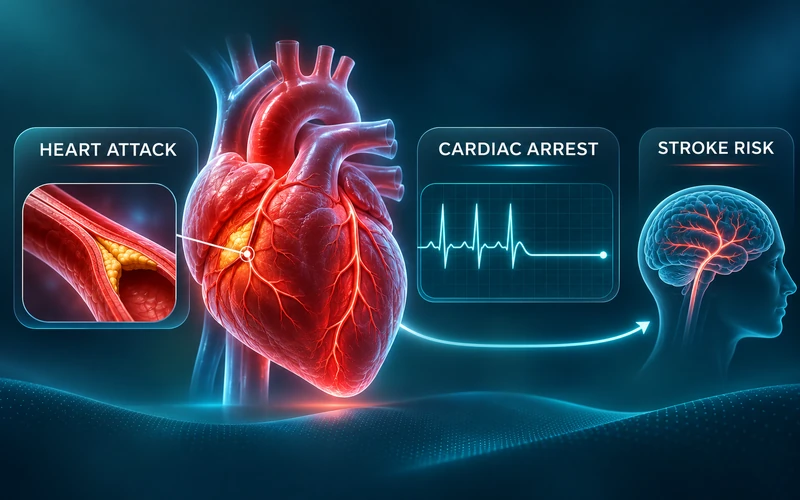
A heart attack is a blockage that cuts off blood flow to the heart, and the person is usually awake. Cardiac arrest is an electrical failure: the heart stops pumping, and the person collapses, unresponsive, not breathing normally. Call 112 and start CPR at once. In an Indian registry of 2,121 CPR cases, only 7.7% of in-hospital and 14.6% of out-of-hospital arrests survived to discharge, which is why the first minutes matter.
This guide covers cardiac arrest signs, heart attack symptoms, survival numbers, treatment at Cardiology Hospital in Delhi, and what to do while help is on the way.
Heart Attack vs Cardiac Arrest: The Difference
People use the two terms as if they mean the same thing. They do not. The American Heart Association explains the split as a circulation problem (heart attack) versus an electrical problem (cardiac arrest), and the NHS notes they need different treatment.
| Heart attack | Cardiac arrest | |
| What fails | Blood flow to the heart muscle is blocked | The heart’s electrical system malfunctions |
| Heart | Still beating | Stops pumping blood |
| Consciousness | Usually awake | Sudden loss of responsiveness |
| Breathing | Usually present, may be short | Absent or only gasping |
| Onset | Builds over minutes to hours | Sudden |
| First action | Call 112, get to a hospital | Call 112, start CPR, use an AED |
| Link | Can trigger cardiac arrest | Can follow a heart attack |
Symptoms of Cardiac Arrest: Signs to Recognise
Cardiac arrest signs appear all at once. According to the US National Heart, Lung, and Blood Institute, a person is in cardiac arrest if they:
- Collapse suddenly and lose consciousness
- Are not breathing, or are only gasping
- Do not respond to shouting or shaking
- Have no pulse
Is there pain in cardiac arrest?
The collapse itself is sudden, and the person is unconscious. Any pain usually comes before it, most often as chest pain or pressure.
Can warning signs show up earlier?
Yes, in many cases. A 2023 study in The Lancet Digital Health, as reported by HealthDay, found that 50% of people who had a sudden cardiac arrest had at least one warning symptom the day before.
| Warning sign before arrest | Who reported it more often |
| Chest pain or pressure | Men |
| Shortness of breath | Women |
| Palpitations | Smaller groups of both |
| Seizure-like activity | Smaller groups of both |
| Flu-like symptoms | Smaller groups of both |
The same NHLBI page says about half of cardiac arrests happen to people who did not know they had a heart problem.
Symptoms of a Heart Attack
Heart attack symptoms can start slowly and may come and go. The NHS lists these, and the WHO adds light-headedness and cold sweat.
| Symptom | What it can feel like |
| Chest pain | Crushing or squeezing, in the centre of the chest |
| Spreading pain | Arm, left shoulder, neck, jaw or back |
| Breathlessness | Short of breath, with or without chest pain |
| Nausea or vomiting | Feeling sick or being sick |
| Indigestion | Burning, fullness or bloating in the chest |
| Sweating | Cold sweat |
| Skin colour | Pale, blue or grey; on darker skin, check the palms |
Women are more likely than men to have shortness of breath, nausea, vomiting, and back or jaw pain, says the WHO. The American Heart Association adds unusual tiredness, anxiety and upper back pressure, though chest pain is still the most common symptom for both sexes.
Cardiac Arrest Survival Time and Treatment
Is cardiac arrest treatment possible? Yes. CPR keeps blood moving, and a defibrillator (AED) shock can restore a normal rhythm. The AHA says immediate CPR can double or triple the chance of survival. Hospital teams then look for the cause and treat it.
How long does a person have? There is no fixed clock. The NHLBI says nine out of 10 people who have a cardiac arrest outside a hospital die, often within minutes. Treat every minute as urgent.
| Measure | Figure |
| Survival to discharge, in-hospital arrest (India) | 7.7% (155 of 1,998) |
| Survival to discharge, out-of-hospital arrest (India) | 14.6% (18 of 123) |
| Out-of-hospital cases that got bystander CPR (India) | 25.2% (31 of 123) |
| Survival to discharge, out-of-hospital arrest (US) | 9.1% |
| Out-of-hospital cases that got bystander CPR (US) | 40.2% |
The Indian registry covered five tertiary hospitals and only 123 out-of-hospital cases, so read those percentages as a snapshot, not a national rate.
Chances of a Heart Attack or Sudden Cardiac Event
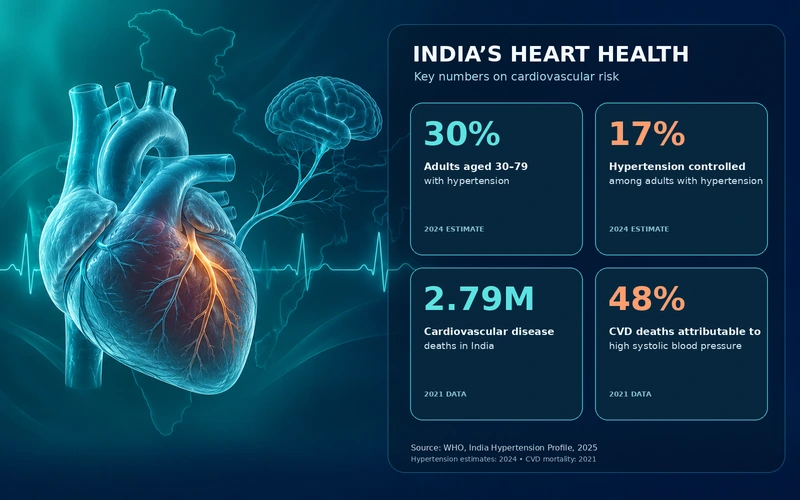
A heart attack is a different event from a brain stroke, though both come from blood vessel disease and often appear together in statistics. The numbers below show how common heart disease is.
| Measure | Figure |
| Global deaths from cardiovascular disease, 2022 | 19.8 million, about 32% of all deaths |
| Share of those deaths caused by heart attack and stroke | 85% |
| Share of deaths in India caused by cardiovascular disease, 2016 | 27% |
| Sudden deaths at AIIMS Delhi autopsies, 2023-24 | 180 of 2,214 (8.1%) |
| Of those sudden deaths, people aged 18-45 | 57.2% |
| Cardiovascular disease as the cause in young adults | 42.6% |
Risk factors for cardiac arrest named by the NHLBI: a previous cardiac arrest, coronary heart disease, heart valve disease, congenital heart defects, and arrhythmias caused by faulty genes. For heart attack, the AHA notes that quitting smoking cuts coronary heart disease risk by 50% after one year.
What to Do in a Cardiac Arrest, Step by Step
These steps follow the Red Cross CPR guidance. A trained person gives compressions and breaths; if you are untrained, call 112 and follow the dispatcher.
- Check the scene is safe, then shout and tap the person.
- If there is no response and no normal breathing, call 112 and send someone for an AED.
- Lay the person on their back on a firm, flat surface.
- Push hard and fast in the centre of the chest: 100 to 120 compressions a minute, at least 2 inches (about 5 cm) deep. Let the chest rise fully each time.
- If trained, give 2 breaths after every 30 compressions.
- Use the AED as soon as it arrives and follow its voice prompts.
- Keep pauses in compressions under 10 seconds, and do not stop until help takes over.
For a suspected heart attack, where the person is awake, call 112, keep them still and get them to a hospital with cardiac care. Do not drive yourself.
If you are looking for a cardiology hospital in Delhi or a heart hospital in Delhi, Kalra Hospitals has cardiology and cardiac surgery departments, an ICU and 24×7 emergency services.