
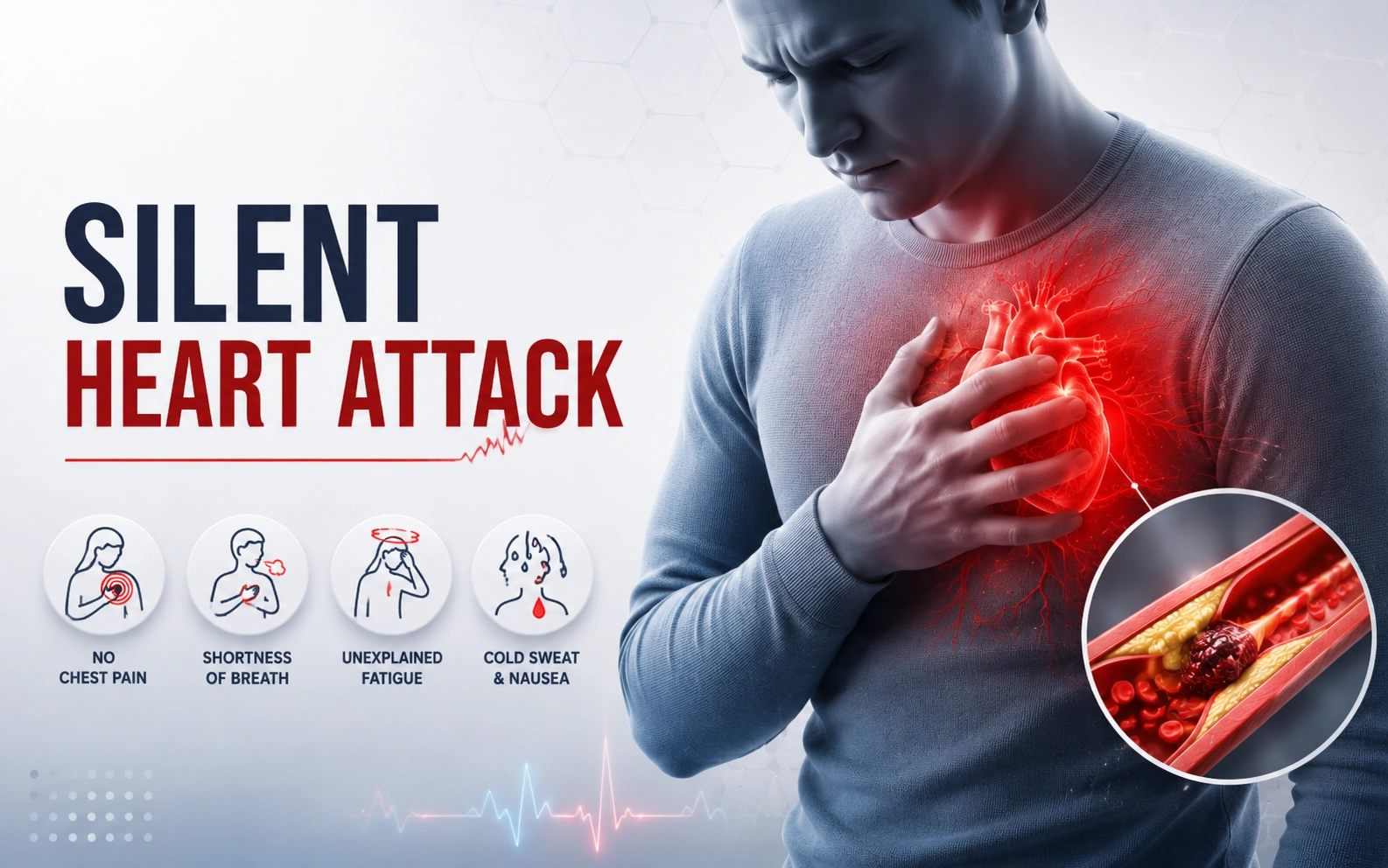
“But I would have felt something.” That’s usually the first reaction people have when a cardiologist explains that the scar tissue on their ECG is from a heart attack they never knew they had. It’s an understandable reaction, and also a dangerous assumption. Roughly 1 in 5 heart attacks cause no obvious symptoms strong enough to be recognised at the time, according to the CDC, which means the belief that “I’d definitely know” is exactly the misconception that lets silent heart attacks slip past unnoticed. Below we discuss what a silent heart attack, and its treatment in Delhi.
What Actually Happens During a Silent Heart Attack?
A silent heart attack, medically called a silent or unrecognised myocardial infarction, follows the exact same physical process as any other heart attack. Fatty plaque inside a coronary artery ruptures, a clot forms, and blood flow to part of the heart muscle gets blocked or severely reduced. Starved of oxygen, that section of heart tissue begins to die and is eventually replaced by scar tissue.
Nothing about that process is inherently “silent.” What differs is how the brain interprets the resulting distress signals, and in some people, those signals simply don’t register as clearly as the textbook chest-clutching heart attack most of us picture.
Why Do Some Heart Attacks Go Unnoticed?
Diabetic neuropathy dulls nerve signals throughout the body, including the ones that would normally register cardiac pain, making silent presentations considerably more common in people with diabetes.
Atypical symptom patterns, more frequently seen in women, tend to look like fatigue, nausea, or mild back discomfort rather than the crushing chest pain typically associated with heart attacks, making them easier to dismiss or misattribute.
Higher pain tolerance or unusual pain perception in some individuals means genuine cardiac distress can register as something mild and forgettable, like a passing ache or brief indigestion.
Older age is also associated with blunted symptom presentation, partly due to age-related changes in how pain is processed.
What Causes a Silent Heart Attack in the First Place?
The causes are identical to those behind any heart attack, only the presentation differs:
- Chronically high blood pressure straining artery walls
- Elevated LDL cholesterol contributing to plaque buildup
- Diabetes, both as a cause and as a factor that specifically increases the odds of a silent presentation
- Smoking, which damages the lining of blood vessels
- Excess weight and low physical activity
- A family history of heart disease at a young age
- Long-term, poorly managed stress
Among these, diabetes carries a genuinely distinct significance for silent heart attacks specifically, not just as a general cardiovascular risk factor, but as a direct reason symptoms may not register at all.
Could I Have Had One and Not Know?
It’s worth pausing on this honestly. If you’ve ever had an unusually tired week you couldn’t explain, brief chest tightness you blamed on stress, or a bout of “indigestion” that felt slightly off, none of that automatically means you’ve had a silent heart attack. But if you have diabetes, high blood pressure, or a family history of heart disease, and any of that sounds vaguely familiar, it’s a reasonable enough question to raise with a cardiologist rather than dismiss entirely.
The Mortality Question: Is “Silent” Actually Safer?
No, and this is the part worth taking seriously. A study of older adults in Iceland, published in JAMA Cardiology, tracked outcomes after silent versus recognised heart attacks and found that 13% of people who’d had a silent heart attack died within five years, compared to 8% of those whose heart attacks were identified and treated at the time. That gap exists specifically because silent heart attacks delay treatment, not because the underlying heart damage itself is somehow less serious.
Separately, longer-term research has found that survival after a silent heart attack, roughly half of patients living beyond 10 years, closely tracks survival after a recognised one, both considerably lower than survival rates in people who’ve never had a heart attack. In other words, the absence of symptoms doesn’t buy you a better outcome. If anything, it removes the early warning that would normally trigger faster treatment.
How Doctors Actually Find a Silent Heart Attack
Since there’s rarely a dramatic moment prompting a hospital visit, silent heart attacks tend to surface during:
- A routine ECG that shows patterns consistent with old heart damage
- An echocardiogram revealing a section of the heart wall that isn’t contracting normally
- Blood tests picking up on residual cardiac markers
- A cardiac MRI or CT scan showing scar tissue
- A stress test uncovering reduced blood flow that wasn’t otherwise apparent
This is why cardiologists in Delhi suggest that screening is the more reliable strategy for people with meaningful risk factors.
Silent Heart Attack Treatment in Delhi
Once discovered, treatment doesn’t differ from that of a recognised heart attack. It typically includes medication to manage cholesterol, blood pressure, and clotting risk, structured lifestyle changes around diet, activity, and smoking cessation, supervised cardiac rehabilitation, and, depending on the extent of arterial blockage, procedures like angioplasty or bypass surgery. The goal throughout is the same: prevent further damage and reduce the risk of a second, potentially more dangerous, cardiac event.
The belief that you’d “definitely know” if you had a heart attack is exactly the assumption silent heart attacks quietly disprove. The damage is real whether or not it’s felt, and the outcomes depend heavily on catching it, through screening, not symptoms alone. If you carry risk factors like diabetes, high blood pressure, or a family history of heart disease, Kalra Hospitals in Delhi can help you find out where you actually stand.
Kalra Hospitals has focused specifically on cardiac care with dedicated Cardiology and Cardiac Surgery departments. For anyone with diabetes, high blood pressure, or a family history of heart disease, Kalra Hospitals offers the full range of diagnostic tools to check rather than assume.